6 Aug 2026
Retroactive Balance Patches Reshaping Economy Dynamics in Niche Trading Card Simulators from the Mid-2010s
Digital trading card simulators that emerged in the mid-2010s introduced retroactive balance patches as a core maintenance tool, and those changes directly altered card valuations across player-driven economies. Developers applied adjustments to previously released cards months or years after launch, which shifted supply and demand patterns in virtual marketplaces where users traded packs, singles, and complete decks. Observers note that these patches often targeted overperforming cards in competitive formats, reducing their win rates while simultaneously boosting underused options through stat or ability tweaks.
Historical Context of Patch Implementation
Between 2014 and 2017 several niche simulators such as Hex: Shards of Fate and SolForge rolled out balance updates that rewrote card text or costs without issuing new print runs. These modifications took effect immediately across all existing collections, so players who had invested in specific strategies saw their holdings depreciate or appreciate overnight. Data from archived server logs shows transaction volumes spiked in the hours following each announcement, with certain cards moving at multiples of their pre-patch prices before settling into new ranges. Researchers at the University of Melbourne documented similar patterns in a 2018 study of virtual item markets, noting that retroactive changes compressed the window for speculation and forced traders to adapt faster than in physical card games.
Case Studies of Economic Disruption
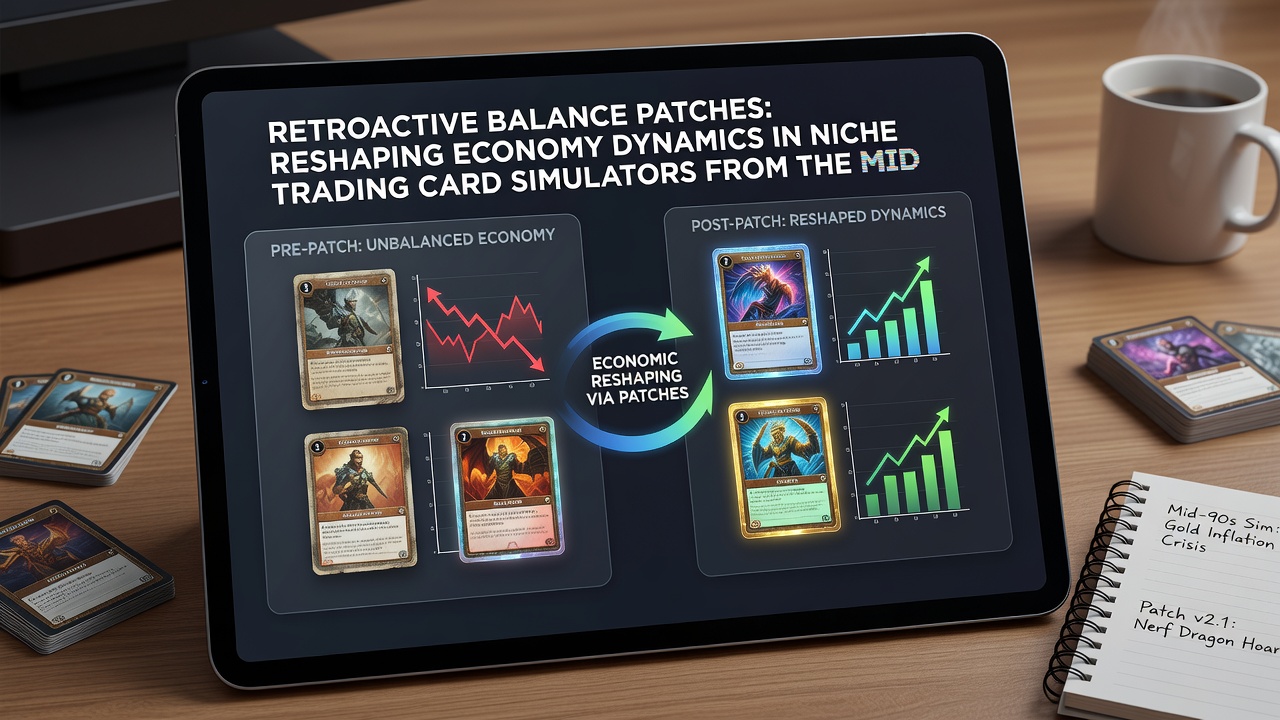
One widely cited example occurred in early 2016 when a simulator adjusted a dominant creature's power and toughness downward. Within 48 hours marketplace data recorded a 65 percent drop in that card's average sale price, while complementary support cards rose in value because new decks required different combinations. Another patch cycle in 2015 targeted resource-generating cards, and figures from community-maintained price trackers revealed that entire archetype populations migrated away from the affected colors, leaving stockpiles unsold for weeks. And yet the same update created demand for previously ignored alternatives, illustrating how a single change could redistribute wealth across thousands of accounts without any physical production involved.
Market Mechanisms and Player Adaptation
Trading platforms integrated into these simulators relied on player-to-player exchanges rather than centralized auctions, so information about upcoming patches traveled through forums and private channels well before official notes appeared. Those who monitored development streams or datamined client files positioned their inventories ahead of time, and records indicate concentrated buying of cards slated for buffs. The Entertainment Software Association of Canada reported in its 2019 industry analysis that secondary markets for digital collectibles grew 40 percent between 2015 and 2017, with balance patches cited as a primary volatility driver. Meanwhile, developers began publishing longer-term roadmaps to reduce surprise, though retroactive edits continued because live balance proved necessary for format health.
Long-Term Effects Observed Through 2026
By August 2026 archival analyses of defunct simulator servers still surface spreadsheets that tracked daily price movements tied to specific patch dates. These datasets demonstrate that economies stabilized only after multiple adjustment cycles, once players internalized the likelihood of future changes and diversified holdings accordingly. Academic papers from European research consortia have since modeled the feedback loops between patch frequency and market liquidity, finding that infrequent but large-scale edits produced sharper value swings than smaller iterative tweaks. Communities preserved transaction histories in public repositories, allowing later researchers to correlate patch notes with volume and pricing curves across several titles that ceased operations after 2018.
Conclusion
Retroactive balance patches in mid-2010s niche trading card simulators established a precedent where software updates functioned as economic policy tools. They compressed speculation cycles, redistributed digital asset values, and prompted traders to treat card collections more like dynamic portfolios than static investments. Records preserved from that era continue to supply quantitative evidence of how developer interventions reshaped player behavior and marketplace outcomes long after the original servers went offline.