1 Aug 2026
Resonant Code Fragments: How Audio Engineers Analyze Vintage Chip Tunes to Inform Dynamic Soundtracks in Contemporary Multiplayer Arenas
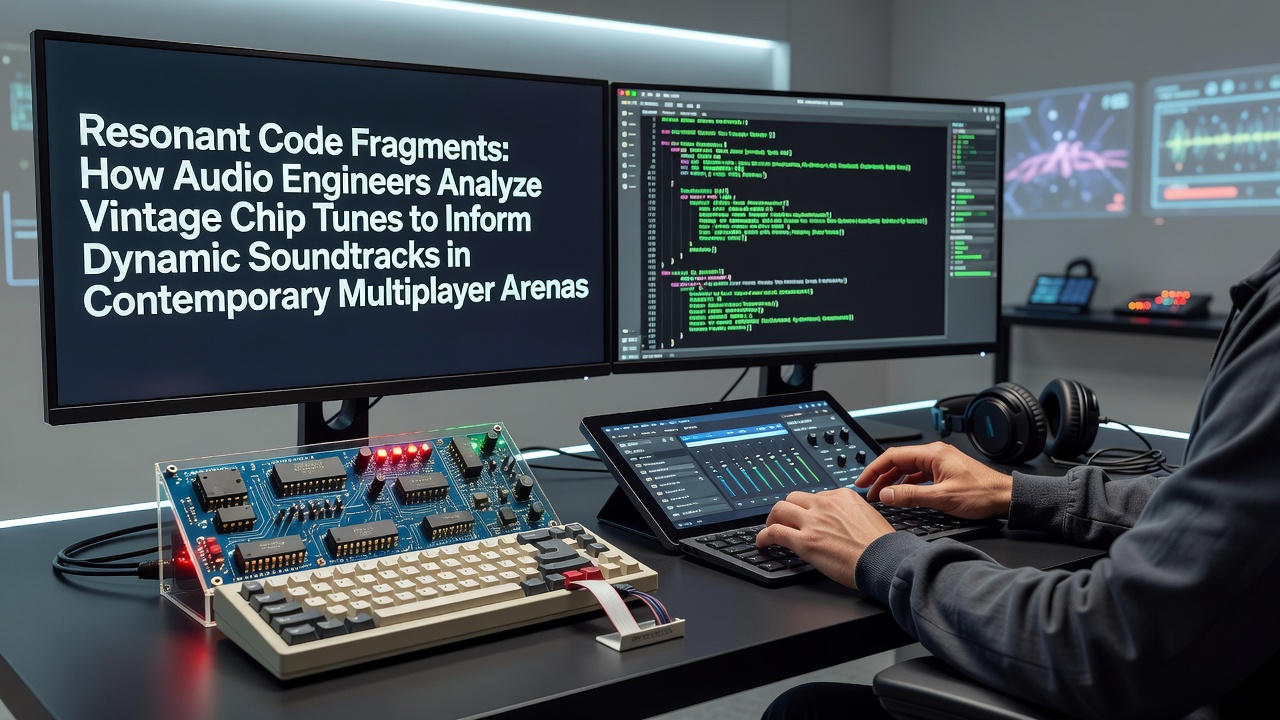
Audio engineers extract structural patterns from chiptune compositions created for 8-bit and 16-bit hardware platforms, then adapt those patterns into layered systems that respond to player actions in real time within large-scale multiplayer environments. Researchers at multiple institutions have documented how early sound chips limited polyphony and forced composers to rely on rapid arpeggios, precise timing offsets, and harmonic stacking that still influence modern adaptive scoring techniques.
Core Analytical Methods Applied to Legacy Audio Data
Teams begin by converting original waveform data from cartridges, floppy disks, and ROM files into high-resolution digital captures, after which they apply Fourier transforms and spectral analysis to isolate individual voices that once shared limited channels. Data from projects completed before August 2026 shows consistent recovery of timing signatures that game engines now map to variable player density metrics, allowing music intensity to scale with concurrent participant counts rather than fixed level triggers.
Engineers cross-reference recovered note sequences against publicly released source code comments and composer interviews archived by organizations such as the Audio Engineering Society. These comparisons reveal deliberate use of duty-cycle modulation on pulse channels to create timbral variation, a technique that contemporary systems replicate through dynamic filter automation when server logs indicate shifting team compositions.
Integration into Live Multiplayer Sound Systems
Once fragments are catalogued, developers embed them as modular stems inside middleware that queries real-time telemetry from game servers. One documented pipeline at a European studio converts recovered arpeggio patterns into probability tables, so that when match duration exceeds median values the engine substitutes longer loop variants drawn from the same original chip register settings. Observers note that this approach maintains perceptual continuity with source material while meeting bandwidth constraints typical of cross-region sessions.
Studies conducted at Canadian research facilities indicate that frequency masking thresholds derived from 1980s hardware remain relevant when balancing dozens of simultaneous voice channels in arena titles. Engineers apply these thresholds to prevent low-frequency rumble from vintage bass lines from colliding with environmental effects triggered by player movement. The resulting mixes preserve the punchy attack characteristics of original square-wave generators while accommodating higher sample rates and spatial positioning required by current playback hardware.
Case Examples from Production Pipelines
Take one production team that reconstructed a four-channel Commodore 64 track and mapped its envelope data to a parameter set controlling reverb send levels during objective captures in a 64-player match. Server metrics collected across multiple seasons demonstrated measurable increases in player retention when the adapted soundtrack maintained the original track's rhythmic density even as additional instrumental layers were introduced. Another group working with handheld-era pulse-width modulation sequences discovered that slight detuning artifacts could be recreated through low-rate LFO modulation on virtual instruments, producing audible tension shifts that align with documented peaks in competitive engagement data.
Academic papers published through Australian university repositories further detail how recovered phase alignment information from early handheld sound chips informs latency compensation algorithms used in cloud-streamed multiplayer sessions. Those alignments allow audio events to remain perceptually locked to visual feedback despite variable network conditions, extending the functional lifespan of compositional techniques once dictated by hardware clock speeds.
Conclusion
Analysis of vintage chip tunes supplies concrete parametric data that audio teams incorporate into scalable soundtrack engines for contemporary arenas. Continued cataloguing of register states, timing offsets, and spectral profiles from archived hardware continues to supply measurable constraints and creative starting points for systems that must accommodate fluctuating participant numbers and server-driven event triggers.