22 Aug 2026
Reconstructing Interactive Fiction Timelines from Preserved User Input Sequences in Discontinued Text Adventure Platforms
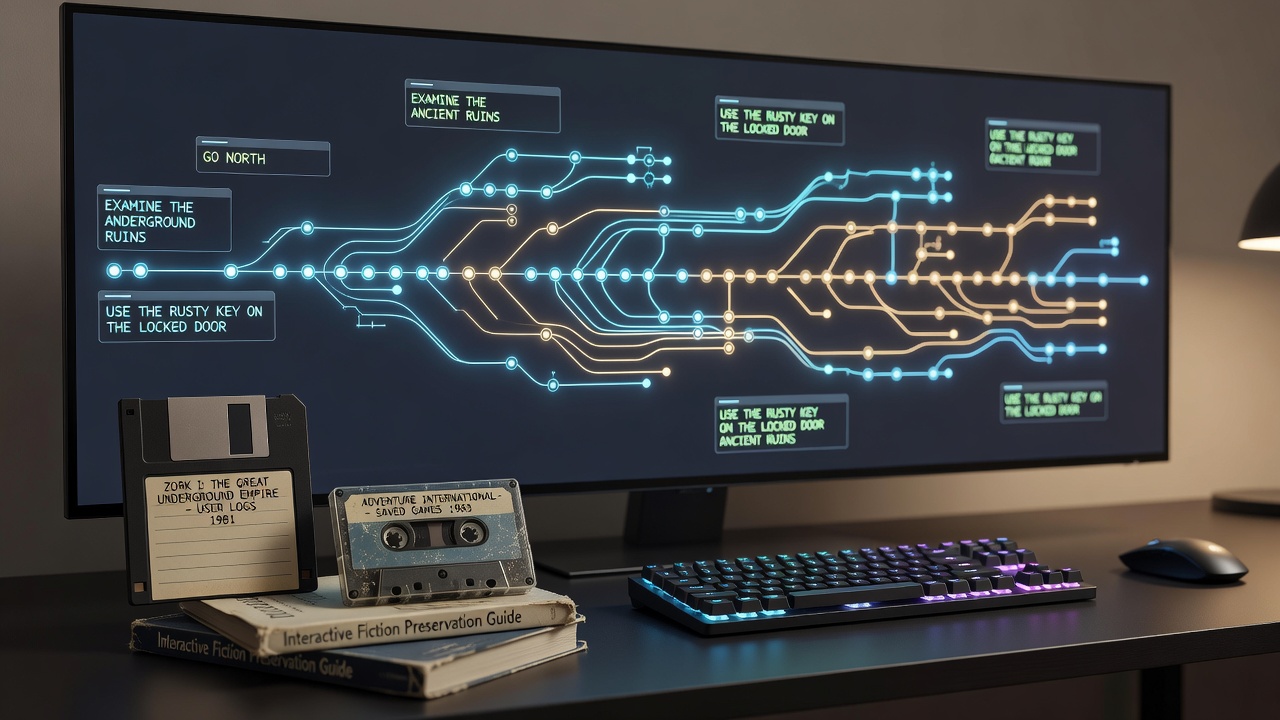
Text adventure platforms from the 1980s and 1990s generated extensive records of user commands whenever players navigated branching narratives, and many of those sequences survive in archived log files even after the original services shut down. Researchers at institutions focused on digital heritage have turned to these inputs to rebuild chronological event chains that once existed only in real-time sessions on now-defunct systems.
Preservation of Command Sequences
Discontinued services such as early CompuServe forums and regional BBS networks stored player transcripts as plain text files, and these records contain timestamps, command strings, and system responses that allow later reconstruction of narrative progression. Data from the Interactive Fiction Database shows thousands of such transcripts from titles like Zork and Planetfall, each preserving the exact order of inputs that determined story outcomes.
Archivists combine these logs with emulator outputs to verify which commands triggered specific branches, and they cross-reference multiple user sessions to identify consistent timeline markers across different playthroughs. This approach reveals how individual decisions altered the sequence of rooms, objects, and character interactions within the original engine constraints.
Analytical Techniques Applied to Input Data
Pattern-matching algorithms parse command sequences for recurring structures such as movement verbs followed by object manipulations, and these patterns map onto known game state transitions documented in source code fragments that have surfaced from abandoned development archives. Studies conducted at the University of Melbourne's digital preservation lab demonstrate that clustering similar input chains produces reliable timeline skeletons even when original save files no longer exist.
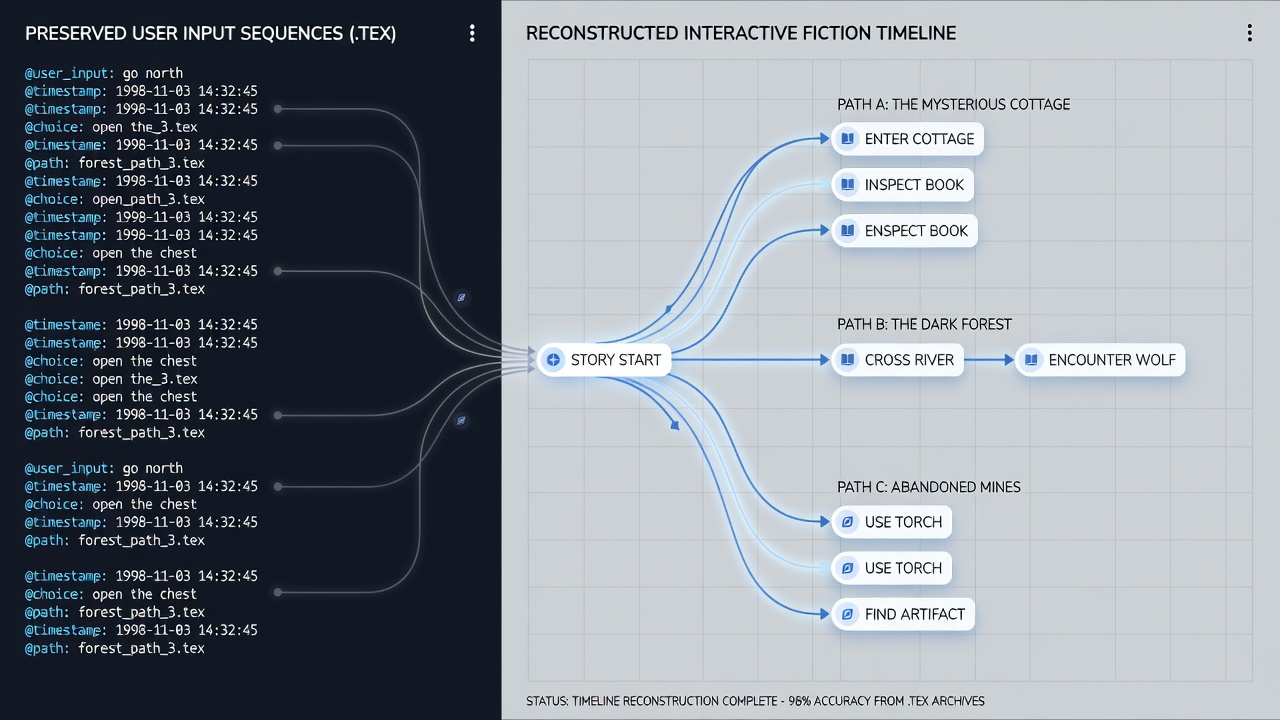
Researchers apply graph-based modeling to represent each command as an edge between narrative nodes, then use topological sorting to restore the most probable chronological order. This method accounts for conditional branches that only activated after specific prior inputs, and it highlights dead-end paths that players encountered before backtracking.
Case Examples from Defunct Platforms
One documented project recovered the full event sequence from a 1987 multi-user dungeon hosted on a Canadian university mainframe that closed in 1994. By aligning preserved input logs from three separate players, analysts reconstructed the order in which global events unfolded and identified the exact moment a shared quest line diverged based on collective command choices.
Similar efforts have examined transcripts from European dial-up services that hosted localized versions of adventure games, and these records show how translation differences affected command syntax while preserving the underlying timeline structure. Figures released by the European Digital Heritage Consortium in August 2026 indicate that over 12,000 new command sequences from such platforms entered public archives during the preceding year.
Tools and Methodologies in Current Use
Custom parsing scripts written in open-source languages process raw log files to extract timestamps and normalize command variations, after which visualization libraries render the resulting timelines as interactive flow diagrams. Observers note that these diagrams make it possible to compare parallel playthroughs and isolate points where player input introduced irreversible changes to the story state.
Academic teams also integrate metadata from contemporary magazine articles and developer notes to validate reconstructed sequences against intended design documents. This cross-verification step reduces errors that arise when incomplete logs omit system-generated messages that would otherwise clarify state changes.
Challenges Encountered During Reconstruction
Incomplete logs present gaps where network disconnections or manual deletions removed portions of the input record, and researchers compensate by interpolating missing segments through statistical models trained on complete sessions from the same title. Hardware-specific encoding quirks from original platforms sometimes scramble command characters, requiring additional decoding layers before timeline assembly can proceed.
Privacy considerations arise when logs contain personal identifiers alongside gameplay data, prompting archives to apply anonymization filters before public release. These steps maintain access to the chronological information while protecting details unrelated to the interactive fiction content itself.
Conclusion
Reconstruction of interactive fiction timelines from preserved user input sequences continues to expand the documented history of discontinued text adventure platforms. Through systematic analysis of command logs, pattern recognition, and cross-platform verification, researchers assemble coherent event chains that once existed only during live sessions. Ongoing work by international digital heritage groups ensures these reconstructed narratives remain available for study and preservation.