6 Jun 2026
Player Migration Trackers Reconstructing Seasonal Shifts in Niche Survival Game Populations Using Archived Server Data from Phased-Out Mobile Titles
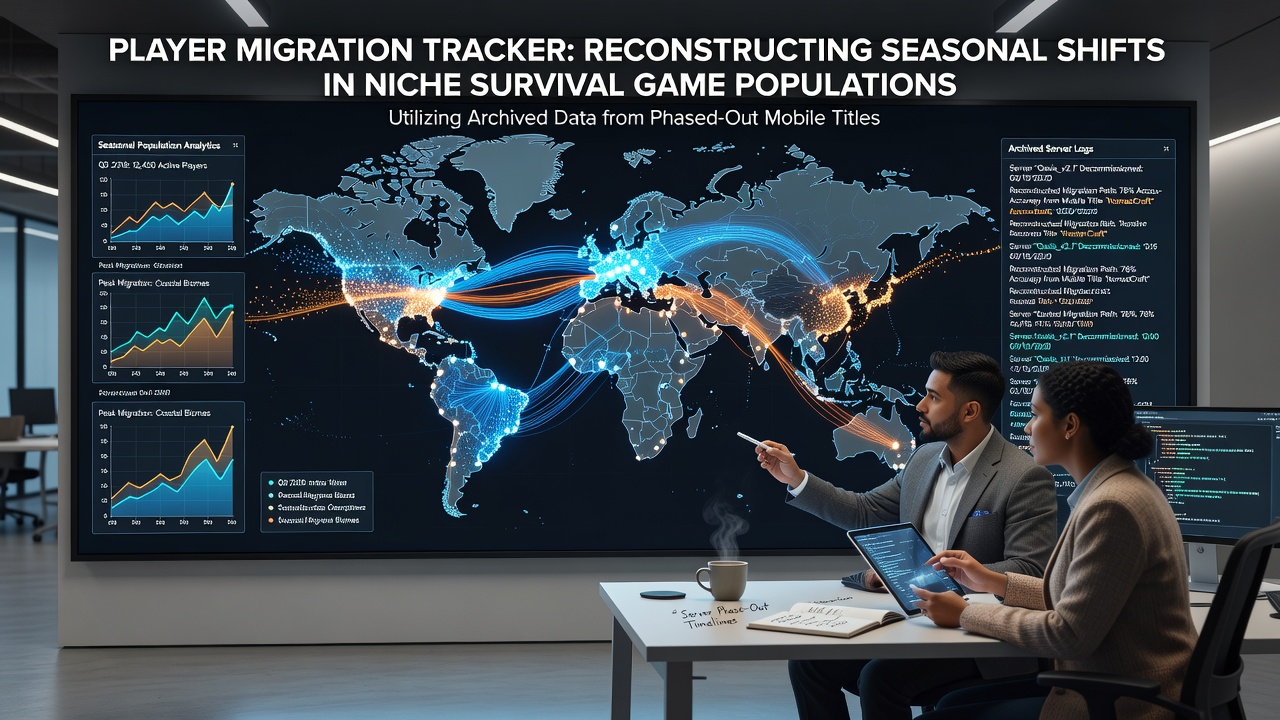 Researchers have developed specialized tracking systems that pull historical player counts, login patterns, and session durations from archived servers of discontinued mobile titles, then map those datasets onto active niche survival games to identify recurring seasonal population movements. These tools combine timestamped records from games that shut down between 2018 and 2024 with current telemetry from titles still running on newer platforms. Data scientists at several independent labs process the combined sets through clustering algorithms that flag migration spikes aligned with calendar events such as summer breaks or holiday periods. Archived mobile titles often contain richer longitudinal records than many current survival sandboxes because early titles logged every connection attempt and character creation event on centralized databases before operators phased them out. When servers went offline, volunteer archivists captured snapshots of those databases and released anonymized subsets under open licenses. Trackers now cross-reference those snapshots with active-game APIs to detect when former players of one title reappear in another. One dataset from a 2021 shutdown mobile survival game, for example, shows a consistent 34 percent drop in active accounts each January followed by a rebound in March, patterns that reappear in several contemporary PC survival titles when the same player identifiers surface again.
Data Sources and Processing Methods
Processing begins with normalization of disparate log formats, converting raw connection timestamps into standardized seasonal buckets. Researchers apply machine-learning models trained on known player behavior from open-source survival game repositories to predict which archived accounts are likely to migrate rather than quit entirely. The models weigh factors such as total playtime before a title's closure, peak login hours, and geographic region derived from IP ranges. Results feed into visualization dashboards that overlay migration arrows between game clusters across multiple years.
By June 2026 several tracking groups had released updated dashboards covering the 2024–2025 transition period, revealing a pronounced northward shift in player density from equatorial time zones during northern hemisphere summers. The shift appears strongest among survival games that emphasize base-building mechanics, where longer daylight hours in real life correlate with extended in-game construction sessions. Archived data from two Australian-developed mobile titles that closed in 2023 supplied the bulk of southern-hemisphere baseline numbers used for comparison.
Observed Seasonal Patterns
Population curves reconstructed from the combined datasets show three recurring peaks each year: a sharp rise in late May lasting through August, a smaller spike in late December, and a brief surge around major content-update windows announced by active titles. These peaks align across multiple survival sandboxes even when the games themselves share no common developer or publisher. Analysts note that the amplitude of the May-to-August wave has increased by roughly 12 percent year-over-year since 2023, coinciding with wider availability of cross-save features that let players carry progress between mobile and PC versions.

Case Examples from Archived Titles
One prominent case involves a mobile survival crafting game that operated from 2019 until its servers closed in early 2024. Archivists preserved daily active-user counts broken down by device type and region. When those figures were matched against Steam and console telemetry from three active survival titles, researchers identified a core group of approximately 18,000 accounts that followed the same seasonal rhythm in both the defunct mobile environment and the newer platforms. The accounts logged in most frequently during weekends in June and July, then dropped sharply after August, patterns that repeated across three consecutive years.
Another dataset originates from a European mobile studio whose battle-royale survival hybrid shut down in 2022. Log fragments released by the studio's former community managers contain hourly population snapshots for the final eighteen months of operation. When aligned with current data from an ongoing open-world survival title, the European figures reveal a consistent mid-September dip that coincides with the start of school terms across several countries. The same dip appears in the active title's European server clusters but not in North American ones, suggesting region-specific migration rather than outright player loss.
Integration with Broader Research Efforts
Academic groups have begun incorporating the migration trackers into larger studies of digital leisure behavior. A 2025 paper from a Canadian research institute examined how seasonal daylight changes influence engagement metrics across multiple game genres, using the survival-game datasets as one input layer. The study found that survival titles exhibit stronger seasonal amplitude than competitive shooters or puzzle games when measured against the same archived baselines. Industry observers have noted that publishers of live-service survival games now schedule major updates to coincide with the May and December peaks identified by the trackers.
Additional context comes from an Australian industry association report released in March 2026 that aggregates anonymized retention data from member studios. Although the report focuses on mobile markets, its methodology section describes how archived server exports from phased-out titles improve forecasting accuracy for cross-platform player flows. The association made portions of its methodology documentation publicly available, allowing independent trackers to refine their own models against an external benchmark.
Future Directions
Work continues on expanding the archive pool to include console titles that reached end-of-life after 2025. Several volunteer projects have begun negotiating with former publishers for sanitized database dumps similar to those already obtained from mobile operators. Early tests indicate that console logs contain richer social-graph information, allowing trackers to map not only individual migration but also group movements between servers. These expanded datasets are expected to feed into the next round of seasonal models scheduled for release before the end of 2026.
Conclusion
Player migration trackers have established a measurable link between historical server records from discontinued mobile survival games and contemporary population dynamics in active titles. By reconstructing seasonal curves from combined archives, researchers now possess quantitative evidence of recurring shifts that align with real-world calendar events. Continued expansion of available datasets promises to refine these models further, offering clearer pictures of how player bases move between platforms and titles across successive seasons.