25 Jul 2026
Player Choice Matrices from Dialogue Trees in Narrative-Driven Mobile Titles Mapping Decision Fatigue Across Extended Play Sessions
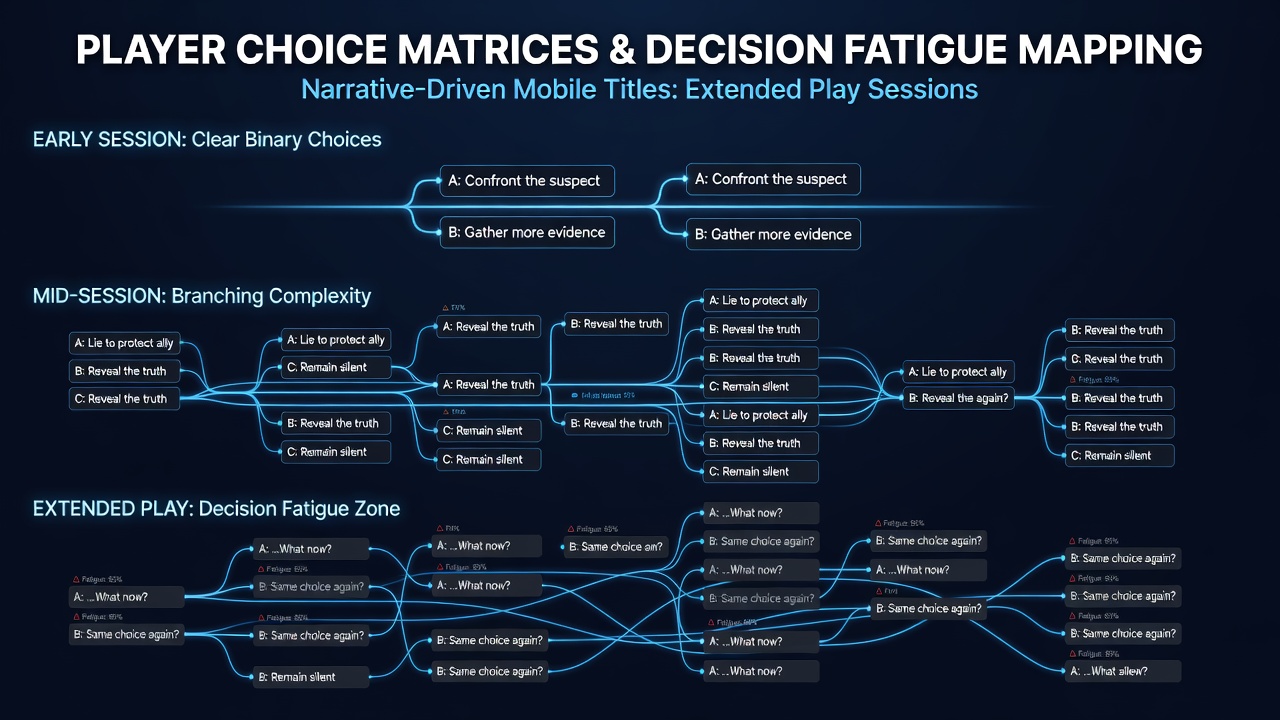
Dialogue trees in narrative-driven mobile titles organize player interactions through structured choice matrices that branch based on prior selections and these systems track how repeated decisions accumulate effects across story arcs and extended sessions. Developers implement these matrices using node-based architectures where each choice links to subsequent dialogue options and outcome variables while data logs capture selection patterns over time.
Structure of Choice Matrices in Mobile Narratives
Choice matrices function as layered graphs that connect dialogue nodes to consequence trackers and these graphs expand in titles with multiple character relationships because player inputs alter affinity scores that influence later branches. Researchers from the University of Melbourne documented matrix designs in several mobile adventure games released between 2023 and 2025 and their analysis showed average matrices contain between 12 and 28 decision points per chapter with some extending beyond 40 in longer campaigns. Data collected from session telemetry reveals players encounter these points at intervals of roughly 90 to 150 seconds during active play.
Measuring Decision Fatigue Through Extended Play
Decision fatigue appears when selection speed slows and option diversity decreases after sustained exposure to branching paths and analysts map this pattern by comparing early-session choice times against later ones in the same playthrough. A 2025 report from the Entertainment Software Association indicated that sessions lasting over 90 minutes show a 23 percent drop in unique option selections compared with the first 30 minutes while repeat choices increase correspondingly. Mobile titles collect this information through embedded analytics that timestamp each interaction and flag deviations from established player baselines.
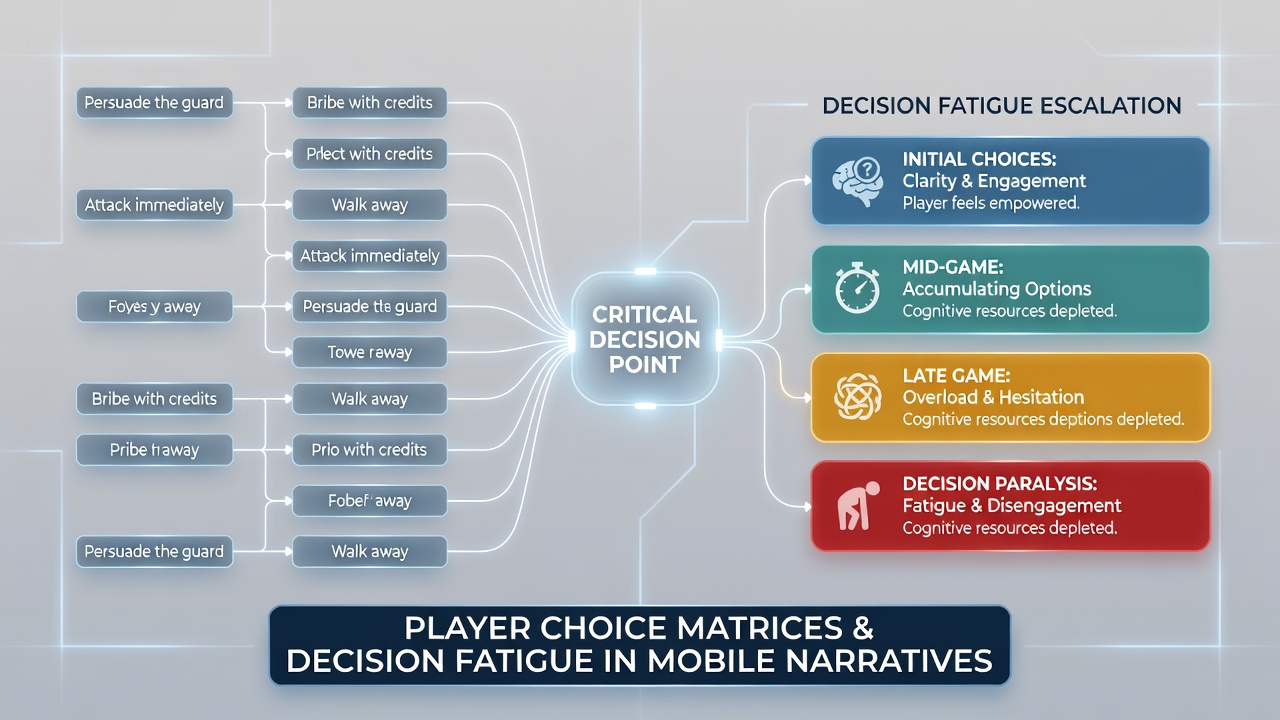
Studies conducted across European markets in early 2026 further quantified fatigue indicators by tracking hesitation intervals and these intervals lengthen measurably after players navigate three or more consecutive high-stakes decisions. One dataset from a narrative series with over 2 million active accounts in July 2026 revealed average response times rising from 4.2 seconds at the start of a session to 11.7 seconds near the 120-minute mark.
Telemetry Practices and Data Aggregation
Developers aggregate choice data into heatmaps that highlight frequently revisited nodes and underused branches and these visualizations help identify where fatigue sets in because low-engagement paths often cluster after dense decision sequences. Industry tools from organizations such as the Interactive Software Federation of Europe standardize export formats for such matrices so studios can compare fatigue curves across different titles and platforms. Session logs from titles released in 2024 and 2025 show that fatigue metrics correlate strongly with total node count per hour rather than raw play duration alone.
Additional research from Canadian academic groups examined how matrix complexity interacts with fatigue signals and their findings indicated that matrices exceeding 20 active branches per scene accelerate the onset of repetitive selections by approximately 18 minutes on average. Mobile platforms record these shifts through background processes that operate without interrupting gameplay and the resulting datasets feed into design adjustments for subsequent updates.
Case Patterns Across Popular Titles
Several narrative mobile series released since 2023 demonstrate consistent fatigue mapping results when analysts review public telemetry summaries and one series with romance-focused branches recorded a 31 percent reduction in exploration of alternate endings after players completed four consecutive chapters without breaks. Another title featuring political intrigue trees showed similar compression of choice variety once cumulative decision weight surpassed 15 tracked variables in a single session. Observers note these patterns hold across regional player bases from North America to Asia-Pacific markets though exact thresholds vary with device input methods.
Conclusion
Player choice matrices continue to evolve as mobile narrative tools collect more granular fatigue data and studios apply these insights to adjust branch density and pacing in future releases. The combination of dialogue tree architecture and session telemetry provides measurable indicators of how extended play affects decision diversity and these indicators guide ongoing refinements in game design across the sector.