9 Jul 2026
Layered Neural Net Analyses Reconstructing Emergent AI Behaviors from Archived Mobile Strategy Match Logs
 Analysts apply layered neural networks to large collections of archived match logs from mobile strategy titles, and these systems identify decision patterns that emerge across thousands of games rather than relying on predefined scripts. The approach treats each log entry as a sequence of states and actions, allowing models to trace how opposing forces adapt over time without direct programming for those adaptations. Data from titles released between 2015 and 2022 supplies the bulk of training material because those games produced consistent, timestamped records of unit movements, resource allocations, and opponent responses.
Data Preparation and Log Structuring
Teams first normalize the raw logs by converting proprietary formats into standardized tensors that capture player positions, resource counts, and AI-controlled unit behaviors at fixed intervals. This preprocessing step removes corrupted entries while preserving temporal order, which matters because emergent tactics often appear only after several minutes of play. Researchers at institutions tracking digital entertainment trends note that mobile strategy logs frequently contain between 200 and 800 discrete events per match, creating dense sequences suitable for recurrent and attention-based layers.
Once cleaned, the datasets split into training and validation portions according to match duration and player rank brackets. Stratification ensures the networks encounter both early-game rushes and late-game attrition scenarios during learning. External validation draws on anonymized aggregates published by industry groups such as the Entertainment Software Association, which tracks participation metrics across regions without revealing individual session details.
Network Architecture Choices
Layered architectures typically combine convolutional layers for spatial feature extraction with recurrent layers for sequence modeling and transformer blocks for long-range dependency capture. The convolutional stages identify local patterns such as clustered unit formations, while recurrent components track how those formations evolve across turns. Attention mechanisms then weigh which earlier decisions most strongly influence later outcomes, revealing the pathways through which unexpected strategies arise.
Training proceeds with supervised signals derived from known victory conditions and unsupervised signals that highlight deviations from baseline AI behavior. Gradient updates focus on minimizing prediction error for the next action given the current board state, and regularization terms discourage overfitting to particular game versions. Studies conducted through Australian research networks have shown that hybrid models achieve higher reconstruction accuracy than single-architecture approaches when tested on held-out match logs from multiple titles.
Reconstruction of Emergent Patterns
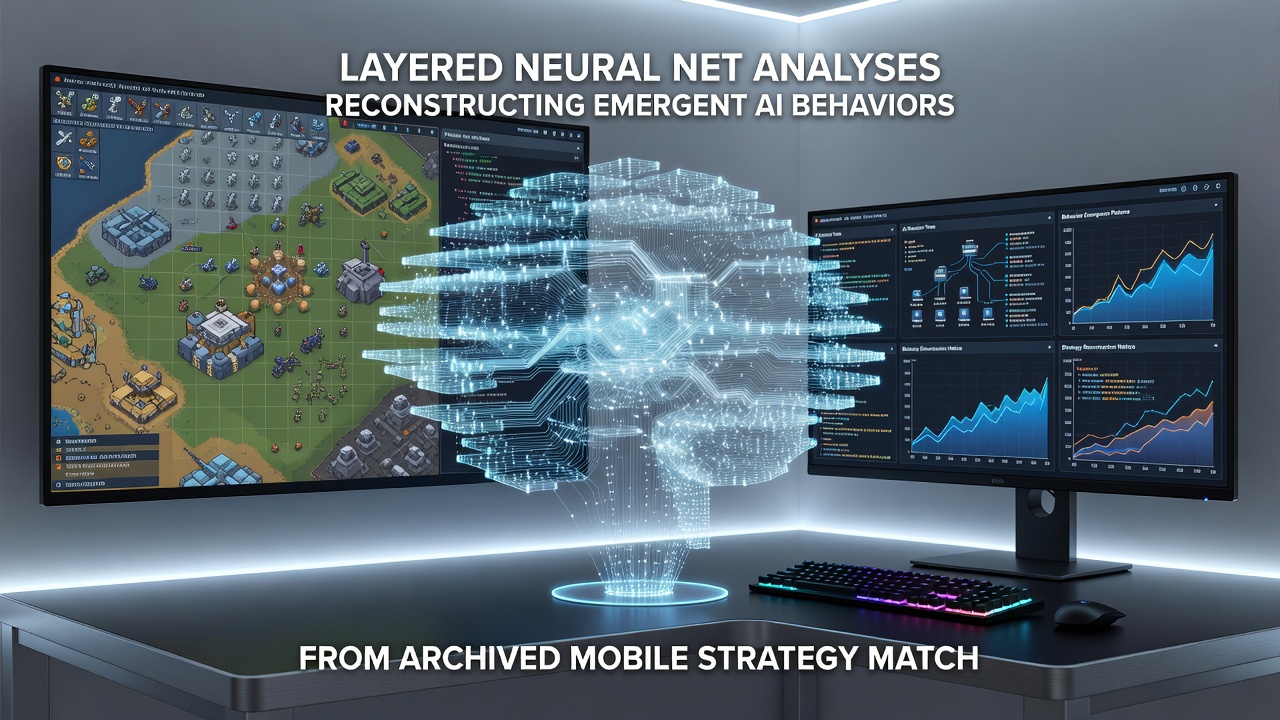
After training, the networks generate counterfactual simulations that replay matches with altered starting conditions, exposing which variables trigger specific emergent responses. One documented case involved an AI-controlled faction developing a defensive perimeter that only activated after resource depletion reached a threshold not explicitly coded in the original ruleset. The layered analysis isolated the contributing log features and mapped them back to earlier resource-gathering decisions made by opposing players.
Similar reconstructions have identified timing-based feints where AI units feigned retreat before committing to an ambush. These behaviors surfaced across multiple titles yet remained invisible to rule-based debugging because no single log entry contained the full sequence. Observers note that attention heatmaps produced by the models consistently assign higher weights to mid-match transitions rather than opening or closing phases, aligning with the periods when resource economies stabilize.
Applications in Ongoing Research
By July 2026 several university labs had integrated these reconstruction pipelines into broader studies of adaptive game systems. The pipelines supply synthetic training data for new AI agents designed to counter previously unobserved tactics, and developers incorporate the findings into balance patches for live service titles. Government statistical agencies in Canada have begun referencing aggregated outputs when assessing digital entertainment industry growth, because the reconstructed behaviors correlate with player retention figures across demographic segments.
Cross-validation against independent datasets remains essential. Teams compare outputs from one title's logs against those from unrelated games to confirm that detected patterns generalize rather than reflect idiosyncratic design choices. When discrepancies appear, analysts adjust layer depths or introduce additional regularization, refining the models iteratively.
Conclusion
Layered neural network analysis of archived mobile strategy match logs supplies a systematic method for recovering emergent AI behaviors that traditional inspection overlooks. The combination of spatial, sequential, and attention-based components allows researchers to isolate decision pathways and test their robustness under varied conditions. Continued refinement of these techniques, supported by standardized data practices and multi-regional validation sources, expands the scope of what can be reconstructed from historical game records.