30 Jul 2026
Layered Narrative Structures in Interactive Fiction Apps Reveal Player Choice Impacts Across Multiple Playthroughs
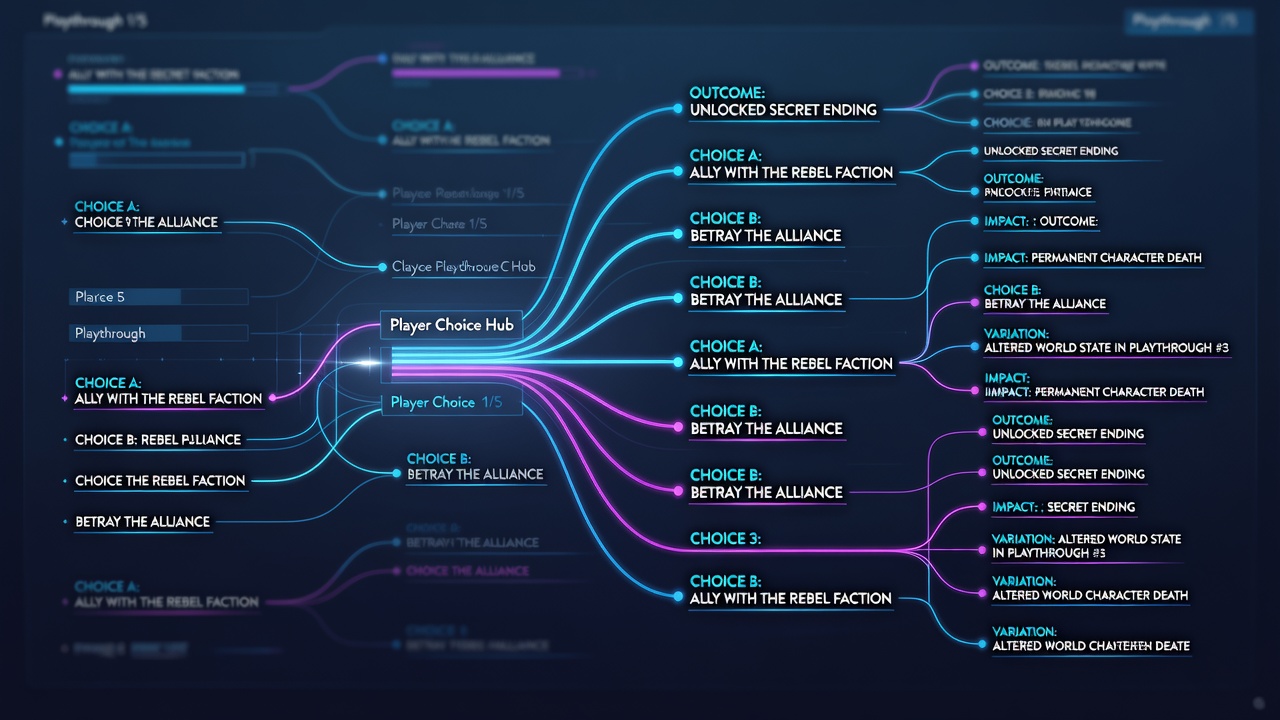
Layered narrative structures in interactive fiction apps organize story elements into multiple overlapping layers that activate or alter based on player decisions made in earlier sessions, and these frameworks track persistent variables across repeated playthroughs to surface cumulative effects rather than isolated branches. Developers implement state machines and memory logs that record selections such as dialogue options, relationship alignments, and environmental interactions, then feed those records into subsequent runs where characters reference prior events or world conditions shift accordingly. Data released in July 2026 from mobile analytics platforms shows rising adoption of such systems in apps exceeding five million downloads, with session lengths extending when users revisit titles to observe altered outcomes.
Core Mechanics Behind Layered Storytelling
Engineers build these systems around persistent databases that store boolean flags, integer counters, and string variables tied to narrative nodes, so one choice to spare an NPC in the first playthrough can unlock hidden dialogue trees or change faction standings in later attempts. Observers note that apps employing this approach often include a meta-layer displaying choice summaries or consequence previews upon replay initiation, allowing users to see how earlier decisions propagate without requiring external note-taking. Research from University of Melbourne scholars indicates that retention rates climb when players encounter these echoes, because the structure rewards experimentation across three or more full cycles rather than single linear completions.
Player Choice Visibility Across Repeated Sessions
Apps surface choice impacts through visual overlays, journal entries that update retroactively, and NPC memory triggers that activate only after specific combinations accumulate, and this visibility turns each new playthrough into an investigative process rather than a fresh start. Take one title where selecting a pacifist route in the opening chapter causes enemy patrols to recognize the player character as non-threatening in the second run, which then opens stealth-alternative paths unavailable before. Studies compiled by the Entertainment Software Association of Canada reveal that developers log an average of 47 distinct variables per major narrative arc, enabling combinations that produce thousands of unique state permutations when players cycle through the content multiple times.

Designers integrate these layers with conditional rendering engines that load or suppress assets based on cumulative player history, and the result appears in environmental details such as changed graffiti, altered weather patterns, or shifted crowd behaviors that reflect aggregate decisions rather than single selections. People who've examined code repositories from popular titles observe that checksum systems prevent tampering with saved states, preserving the integrity of consequence tracking across device resets or cloud syncs.
Technical Implementation Patterns in Current Titles
Teams rely on graph databases to map narrative nodes as interconnected vertices with weighted edges representing choice strength, which allows efficient querying of downstream effects when a player begins a fresh playthrough. Mobile frameworks handle memory constraints by pruning inactive layers until relevant triggers fire, yet retain enough metadata to reconstruct prior impacts accurately. Figures from European Games Developer Federation reports show that titles released after 2024 allocate roughly 18 percent of development resources to building these tracking systems, because accurate consequence display requires extensive testing across randomized play orderings.
And yet the architecture remains invisible to most users until the second or third cycle, when discrepancies between expected and actual events begin to appear. One documented case involves an app that withholds certain companion backstories until the player has completed conflicting alignment paths, forcing discovery only through deliberate replay strategies.
Community Documentation and Data Aggregation
Players compile spreadsheets and wiki entries that catalog variable interactions, turning individual discovery into collective knowledge bases that map hidden layers others might miss during casual runs. These archives often incorporate timestamped logs from beta versions, revealing how developers adjusted consequence thresholds between early access and final release. Academic datasets shared through open repositories demonstrate correlations between the number of tracked variables and average playthrough counts, with apps exceeding 60 persistent flags showing measurably higher completion of alternate endings.
Conclusion
Layered narrative structures continue to evolve as storage and processing capabilities on mobile devices expand, and the ability to reveal cumulative choice impacts across multiple playthroughs now forms a standard expectation in the interactive fiction category. Continued refinement of variable management and visualization tools will determine how deeply future apps can embed consequence memory without overwhelming users or developers.