4 Jun 2026
Heatmap Analytics Exposing Player Migration Patterns Between Aging MMO Servers and Emerging Survival Sandboxes
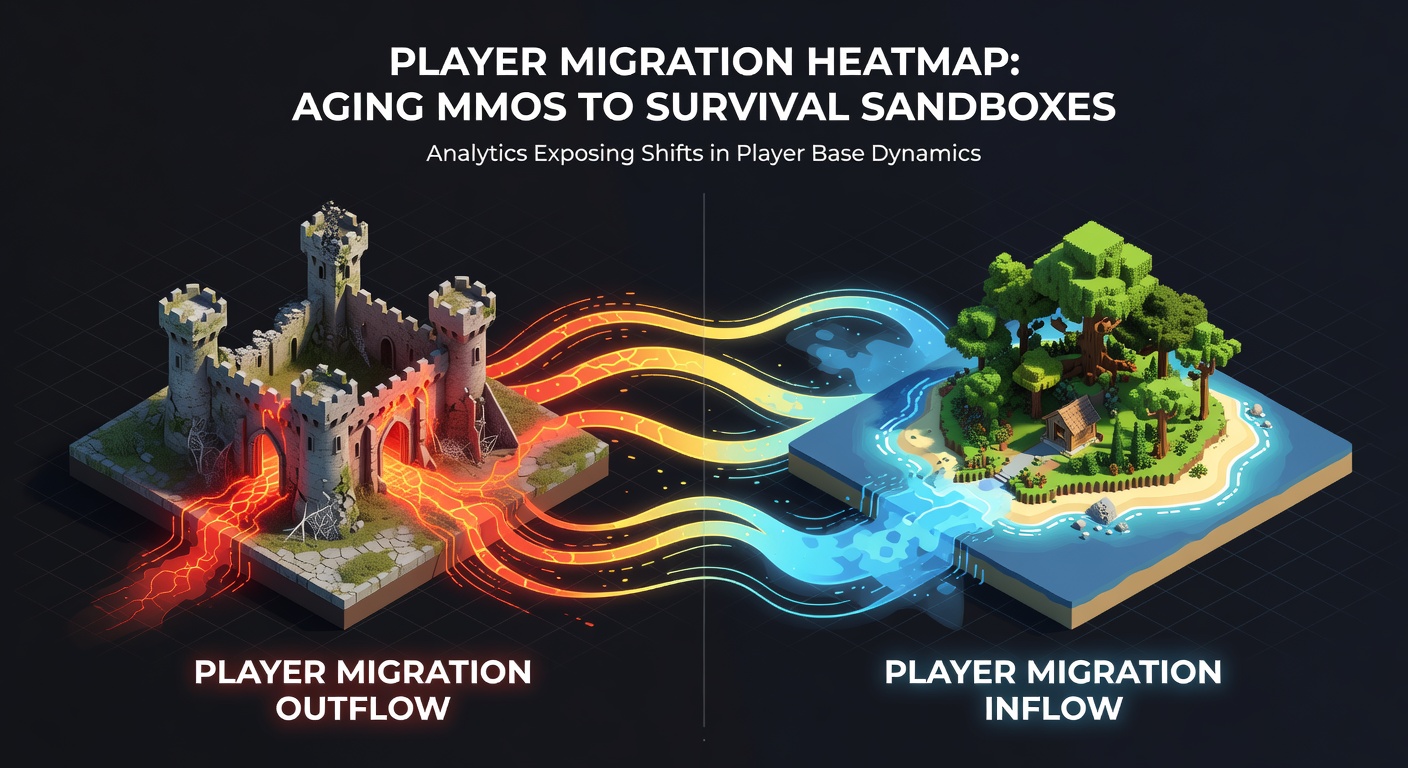
Heatmap analytics have become central tools for tracking how players move between established MMO environments and newer survival sandbox titles, with data layers revealing density changes across server clusters over time. These visual overlays compile login patterns, session durations, and zone transitions from sources like Steam telemetry alongside proprietary developer dashboards, allowing observers to map steady outflows from legacy servers toward emerging survival spaces. In June 2026 analysts noted accelerated shifts coinciding with content droughts on older MMO realms while survival titles released major updates that drew sustained populations.
Mechanics Behind Heatmap Tracking
Developers deploy heatmap systems that aggregate anonymized player coordinates into color-coded grids, where warmer zones indicate high activity clusters and cooler areas highlight abandonment. These tools process terabytes of movement data daily through algorithms that normalize variables such as time of day and patch cycles, producing trend lines that stretch across multiple months. Researchers at institutions like the University of Alberta have applied similar spatial analysis techniques to public datasets, confirming that migration signals appear weeks before official population statistics reflect drops.
Documented Shifts from Legacy MMO Servers
Older MMO servers, particularly those supporting titles launched before 2015, show consistent cooling patterns on heatmaps as veteran groups consolidate into fewer active zones. Players often complete daily routines in capital cities or raid hubs before logging off, leaving peripheral quest areas empty for extended periods. Data compiled by the Entertainment Software Association indicates that average concurrent users on several long-running North American realms declined steadily through early 2026, while European clusters experienced parallel but slightly delayed reductions.
Survival sandboxes display contrasting heat signatures with rapid warming across open-world maps as new players establish bases and expand territories. Titles such as Rust and ARK: Survival Evolved feature persistent structures that generate repeated return visits, creating stable hotspots around resource nodes and player-built compounds. Heatmap comparisons reveal that many incoming accounts originate from MMO backgrounds, with login timestamps overlapping the exact windows when legacy servers register activity lulls.

Regional Variations and Timing Factors
Geographic differences emerge clearly when heatmaps segment data by region, with Australian servers showing quicker transitions toward survival titles during local evening peaks. Time zone alignments mean that evening migrations in one continent coincide with midday lulls elsewhere, producing staggered global patterns that analysts track through synchronized dashboards. Observers note that major content updates in survival games often trigger immediate spikes visible within hours, whereas MMO population rebounds require longer stabilization periods after similar patches.
Server Infrastructure Responses
Hosting providers have adjusted resource allocation based on these analytics, scaling down dedicated MMO instances while expanding capacity for survival sandbox clusters. Database logs cross-referenced with heatmap outputs show increased character transfers and account creations that align with cooling trends on aging servers. Industry reports from the Interactive Software Federation of Europe document how studios now integrate predictive modeling into their infrastructure planning, anticipating further redistribution as survival mechanics evolve.
Community tools built around public APIs allow independent researchers to generate their own overlays, confirming the same directional flows without access to internal telemetry. These third-party visualizations frequently highlight seasonal effects, such as increased survival sandbox engagement during summer months when school schedules free up additional playtime across multiple time zones.
Conclusion
Heatmap analytics continue to document clear redistribution of player activity from established MMO servers toward survival sandbox environments through precise spatial and temporal tracking. The patterns captured in June 2026 and preceding months demonstrate measurable infrastructure impacts alongside evolving developer strategies. Ongoing refinement of these tools supports more accurate forecasting of population movements across both genres.