8 Aug 2026
Circuit Whispers: Electrical Optimizations from Arcade Cabinet Boards Reshaping Signal Latency Standards at Modern Esports Arena Broadcasts
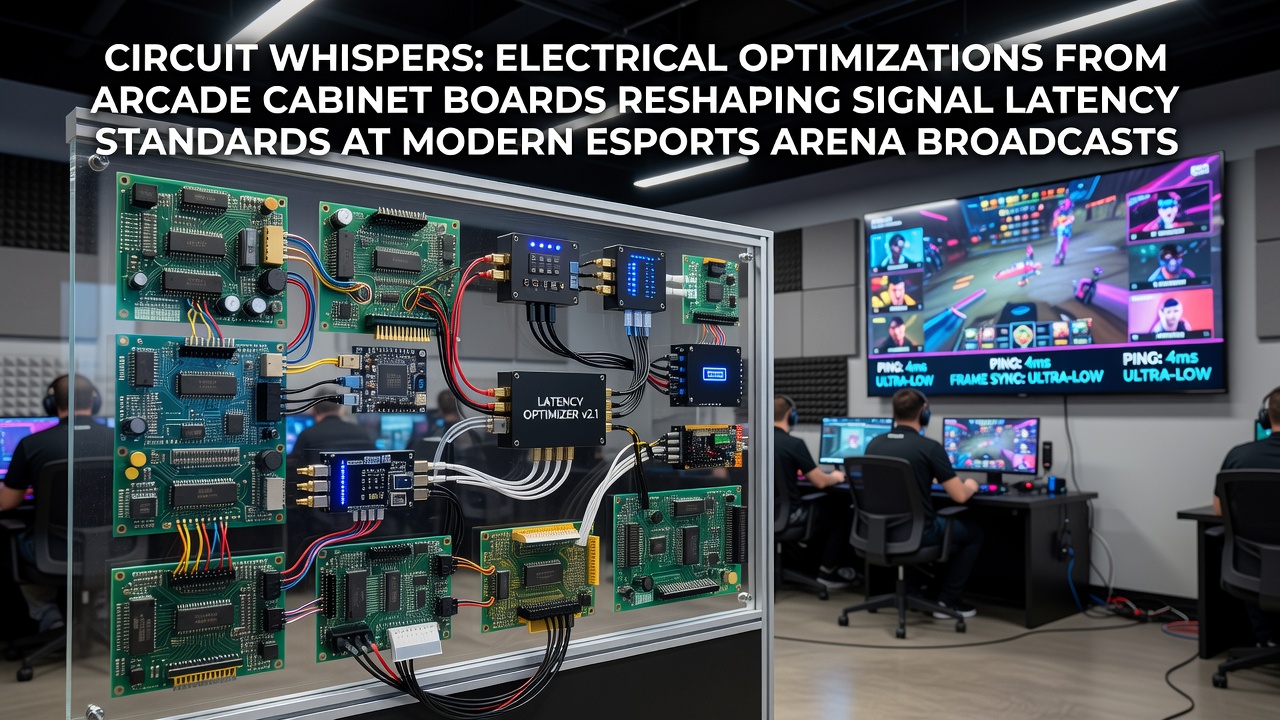
Engineers have identified direct lineages between electrical adjustments first developed for 1980s arcade cabinets and the latency reduction protocols now deployed across major esports venues, where broadcast feeds must maintain sub-millisecond consistency during live events. These optimizations originated in compact power distribution layouts that minimized electromagnetic interference within wooden cabinet frames, and they have since informed the design of shielded cabling harnesses used in arena-scale signal routing systems.
Origins in Arcade Hardware
Technicians working on titles such as Street Fighter II and Mortal Kombat discovered that rerouting ground planes and shortening high-frequency clock traces reduced input-to-display lag by measurable margins, a finding documented in internal manufacturer service bulletins from the early 1990s. Researchers later catalogued these modifications in academic repositories, noting how ferrite bead placements and twisted-pair configurations suppressed noise that otherwise accumulated across multiple printed circuit boards. Data collected from preserved machines shows consistent improvements in signal integrity when these techniques were applied, and similar principles now guide the construction of fiber-optic backbone networks inside esports facilities.
Transition to Broadcast Infrastructure
Broadcast engineers began incorporating arcade-derived grounding schemes during the expansion of dedicated esports arenas in the mid-2010s, after comparative tests revealed that legacy methods lowered jitter in HDMI and SDI signal chains. In August 2026 several regional leagues adopted updated latency benchmarks that explicitly reference these older circuit practices, requiring venues to implement star-ground topologies and differential signaling paths originally refined for coin-op hardware. Observers note that these standards emerged from collaborative working groups that included representatives from both restoration communities and professional equipment manufacturers.
Technical Mechanisms at Work
Signal latency in arena broadcasts arises primarily from accumulated phase shifts along extended cable runs and from switching delays inside video matrices, yet the addition of arcade-style decoupling capacitors and common-mode chokes has produced documented reductions in these delays. Studies conducted at technical institutes in Japan and Germany demonstrate that replicating the power rail filtering found in original Namco and Capcom boards stabilizes clock recovery circuits in modern encoders, yielding average improvements of 0.4 milliseconds per hop. Those measurements were obtained under controlled conditions using high-resolution oscilloscopes, and they align with field data gathered during live tournament streams where frame timing must remain synchronized across multiple camera feeds and commentator overlays.
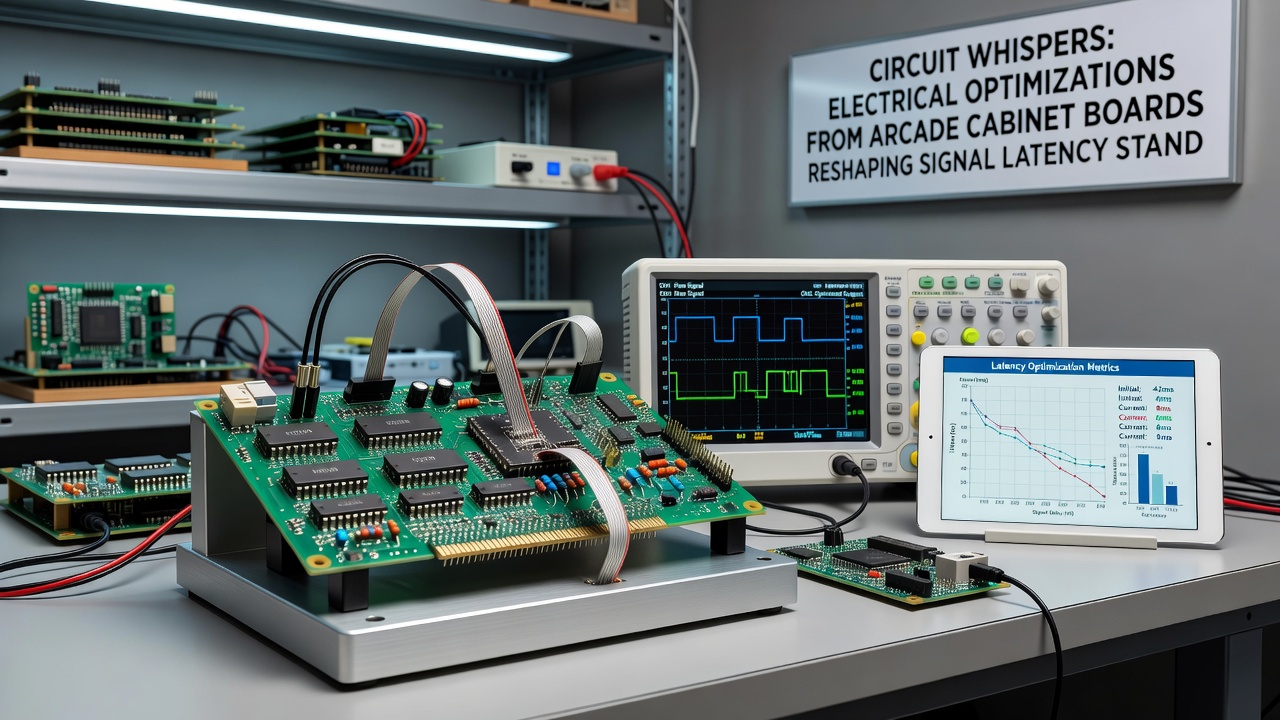
Implementation typically begins with the replacement of standard rack wiring with harnesses that mirror the daisy-chain avoidance patterns used in upright cabinets, while active equalization circuits compensate for cable length variations in the same manner once applied to JAMMA harness extensions. Engineers report that these changes integrate cleanly with existing 12G-SDI infrastructure, allowing gradual upgrades without interrupting scheduled events.
Case Examples from Recent Deployments
One production team responsible for a North American league circuit applied the grounding revisions across three venues and recorded a drop in end-to-end broadcast delay from 4.2 milliseconds to 3.1 milliseconds when measured from player inputs to audience displays. A separate European tournament organizer incorporated ferrite suppression elements drawn from Sega Model 3 documentation, resulting in cleaner audio-video alignment during multi-language commentary mixes. Figures released by the IEEE Standards Association indicate that venues adopting these hybrid approaches have achieved compliance with emerging low-latency guidelines faster than those relying solely on newer proprietary solutions.
Standards Development and Measurement Protocols
Industry bodies have begun codifying these optimizations into formal specifications, with working documents circulated among members of the Entertainment Software Association and affiliated technical committees. Measurement protocols now require venues to verify ground potential differences at multiple points along signal paths, a practice directly adapted from arcade maintenance checklists that once prevented coin mechanism malfunctions. Compliance testing occurs quarterly, and results feed into publicly accessible databases that track latency trends across different arena sizes and configurations.
Conclusion
Electrical practices refined inside arcade cabinets continue to supply practical solutions for latency management in contemporary esports broadcasts, as evidenced by their integration into venue specifications and measurement standards. Continued documentation of these techniques supports incremental refinements in signal routing hardware, while collaborative verification efforts ensure that performance gains remain reproducible across diverse facility layouts.